

We use our teeth for everything—from crushing a crispy apple to flashing a confident grin in a job interview. Yet, many of us view dental care as a chore rather than an investment. If you want to keep your natural teeth well into your golden years, you need more than just a quick brush before bed. It’s about understanding the "why" behind the routine.
Here is how to stay ahead of the curve and keep your pearly whites, well... pearly.
The Chemistry of Brushing (It’s Not Just About Scrubbing)
Most people think brushing is like sweeping a floor—mechanical removal of "dirt." In reality, it’s a chemical process. Your mouth is a constant battleground between demineralization and remineralization.
- The Fluoride Factor: Fluoride isn't just a buzzword; it incorporates itself into your enamel to create a surface that is more resistant to acid.
- Timing Matters: If you drink something acidic (like coffee or soda), wait 30 minutes before brushing. Acid softens the enamel, and brushing immediately can actually "scrub" the weakened enamel away.
The Unseen Enemy: The Biofilm
We call it plaque, but scientists call it a biofilm. This is a sophisticated community of bacteria that builds "fortresses" between your teeth.
- Flossing is Non-Negotiable: A toothbrush only reaches about 60% of tooth surfaces. If you don't floss, you’re leaving 40% of the bacteria to throw a party in the dark corners of your mouth.
- The Systemic Link: Research increasingly shows that chronic gum inflammation (periodontitis) is linked to heart disease and diabetes. Taking care of your gums is literally taking care of your heart.
The Proactive Approach: Diagnostic Dentistry
This is where most people miss the mark. A "check-up" isn't just a cleaning; it’s a high-tech diagnostic session. Modern dentistry focuses on prevention over restoration.
- Early Detection via X-Rays: Many issues, like interproximal cavities (between teeth) or bone loss, are invisible to the naked eye. Digital X-rays allow dentists to catch these before they require a root canal or an extraction.
- Oral Cancer Screenings: During a routine visit, your dentist checks your tongue, throat, and gums for early signs of oral cancer. Early diagnosis has a massive impact on recovery rates.
- Professional Cleanings: Even the best brushers can’t remove tartar (calculus) once it has hardened. Only a professional hygienist with specialized tools can clear that away to prevent gum recession.
Decoding the Dental Aisle: How to Choose the Right Toothpaste
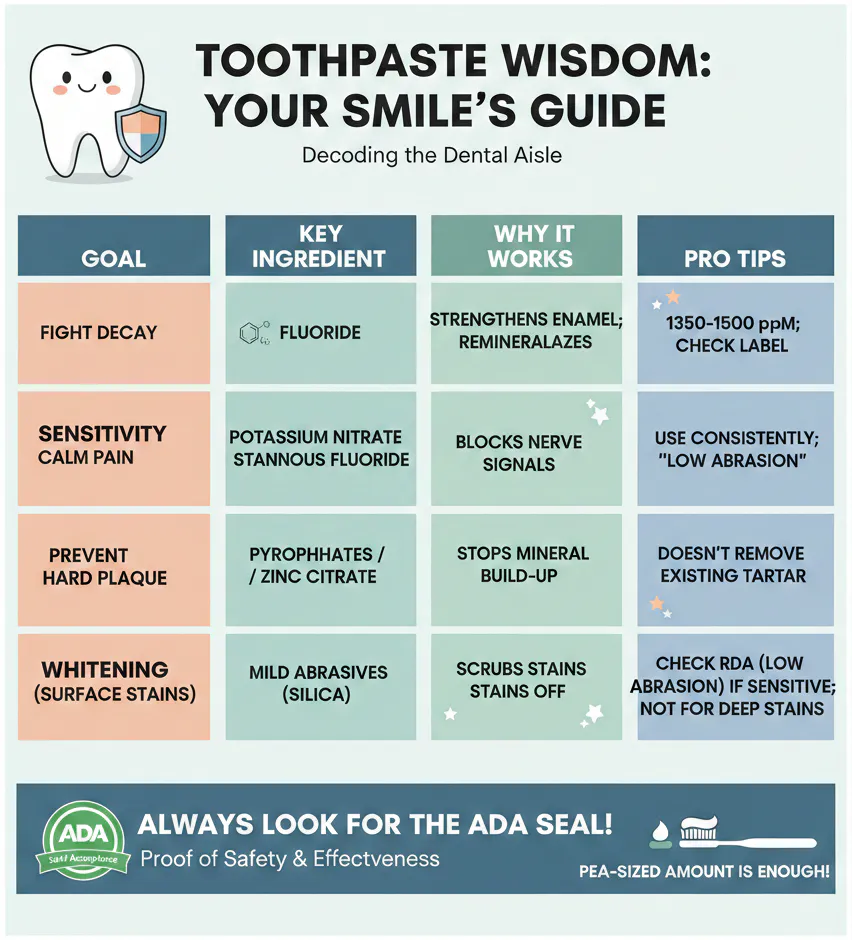
With all the "charcoal," "whitening," and "herbal" labels out there, how do you pick the one that actually works? It’s less about the brand name and more about the Active Ingredients.
When shopping, keep these three criteria in mind:
Look for the "Gold Standard" (Fluoride)
Despite some internet myths, fluoride remains the most important ingredient for preventing tooth decay. It strengthens enamel through a process called remineralization.
- Pro Tip: Look for a concentration of at least 1,350 to 1,500 ppm (parts per million) of fluoride for maximum protection.
Beware of "Whitening" Abrasives
Many whitening toothpastes don't actually bleach your teeth; they use tiny abrasive particles to "scrub" away surface stains.
- The Risk: If a toothpaste is too abrasive (measured by the RDA value—Relative Dentin Abrasivity), it can wear down your enamel over time, leading to sensitivity and a yellow appearance (as the yellowish dentin underneath shows through).
- The Rule: If you have sensitive teeth, look for toothpastes labeled "low abrasion."
Sensitivity vs. Tartar Control
- For Sensitivity: Look for Potassium Nitrate or Stannous Fluoride. These ingredients help block the tiny "tunnels" (tubules) that lead to the nerves in your teeth, dulling the pain of hot or cold drinks.
- For Tartar Prevention: Look for Pyrophosphates or Zinc Citrate. These help prevent plaque from hardening into tartar (calculus) between your professional cleanings.
The Seal of Approval
In the U.S., look for the ADA (American Dental Association) Seal of Acceptance. This seal isn't just a sticker; it means the manufacturer has provided clinical data proving the product is both safe and effective for its intended use.
Quick Tips for a Lifetime of Health:
| Habit | Why it Works |
| Electric Toothbrushes | Use micro-vibrations to break up biofilms more effectively than manual brushing. |
| Drinking Water | Neutralizes pH levels and washes away food debris. |
| Limiting Grazing | Frequent snacking keeps your mouth in an acidic state. Give your saliva time to remineralize your teeth! |
Summary
Long-term dental health isn't about one "big" procedure; it’s about the small, daily habits and the discipline to see your dentist twice a year. Think of your dentist as your smile's "architect"—they provide the blueprint, but you have to do the daily maintenance. Lauderhill Mall Dental P.A. provides a comfortable, friendly, and professional environment for all your dental care needs. An experienced dental team believes that a healthy, beautiful smile can truly change lives. We are committed to delivering personalized, high-quality treatments tailored to each patient’s unique needs.